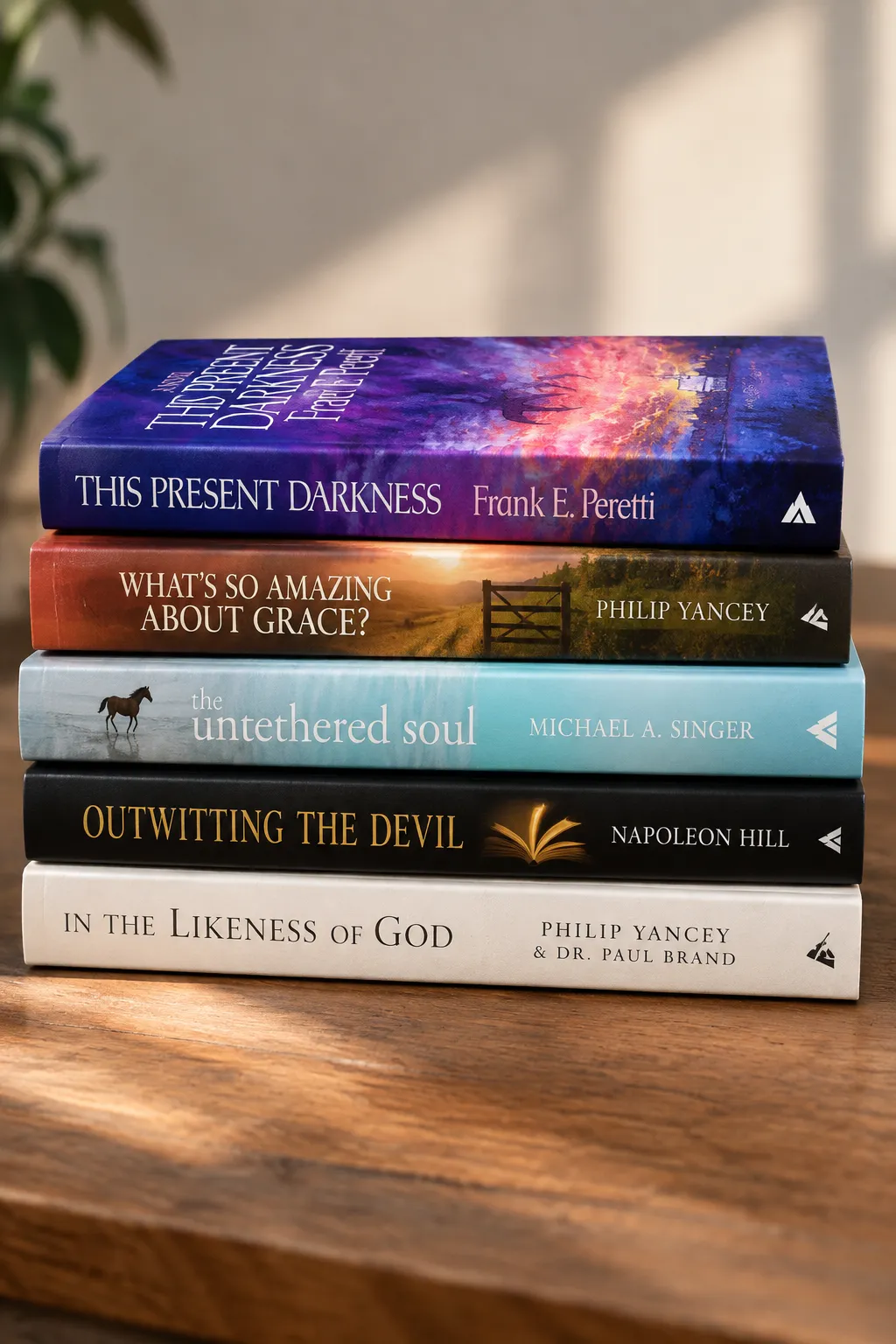
Olivia's Book recommendations
My Book Recommendation
There are books we read and enjoy, books we read and forget, and then there are books that somehow become part of the way we see the world.
Over the years, I have read many books about Christianity, spirituality, faith and the human experience. Some strengthened what I already believed. Others challenged assumptions I did not realise I had. A few caused me to stop, think, question and search the Scriptures more deeply. The five books I want to recommend are not necessarily the five books I would say contain the entirety of Christian truth. Nor do I agree with every theological or philosophical conclusion presented in each of them.
But each one has shaped me.
Together, they have influenced the way I understand the Body of Christ, the systems that shape our thinking, the inner life of the human being, the extraordinary nature of grace and the reality of spiritual warfare. Most importantly, they have encouraged me to think more deeply about what it means to be a believer in Jesus Christ, the Son of God.
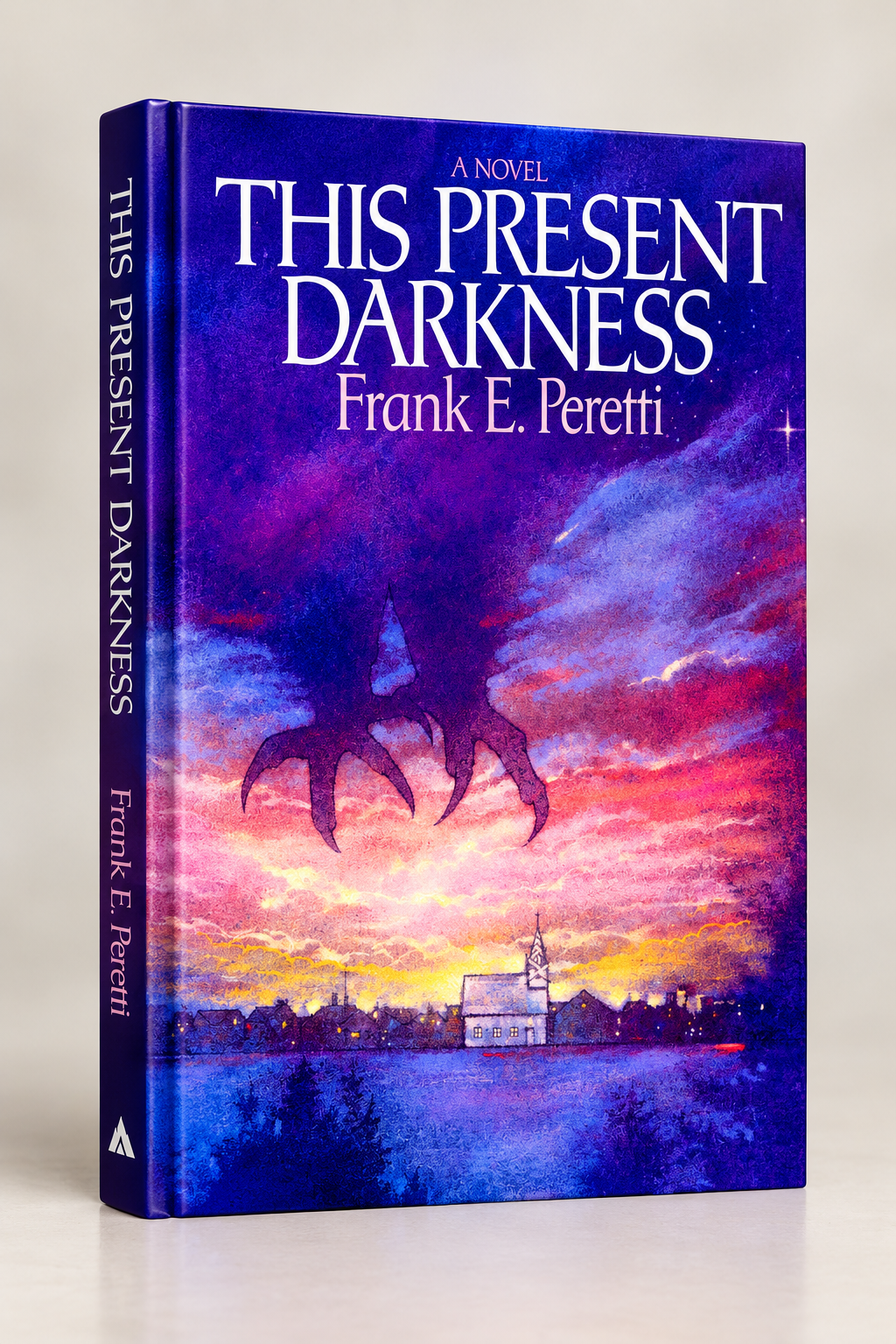
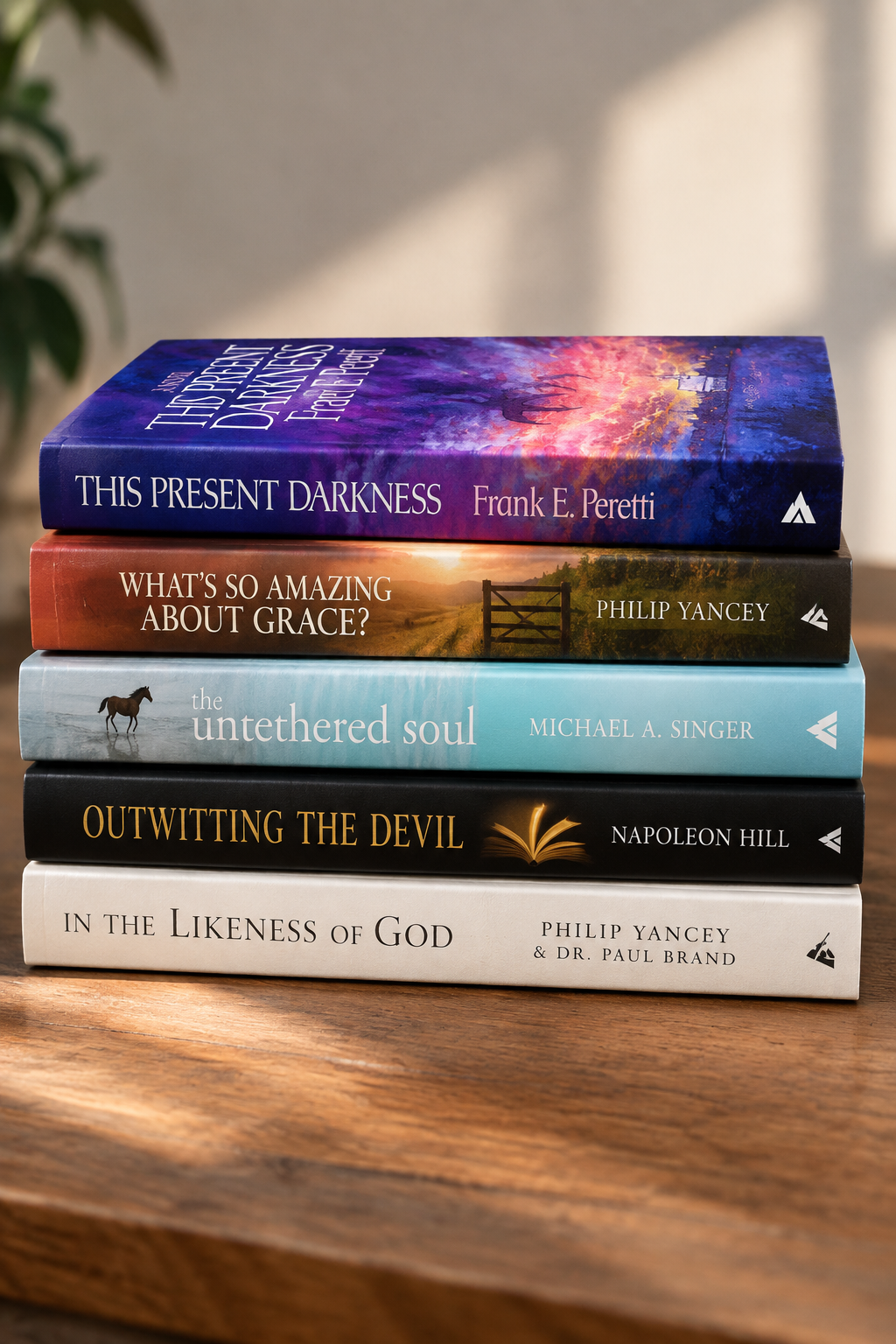
Number 5 on the list: This Present Darkness — by Frank Peretti
Frank Peretti's This Present Darkness was one of those books that changed the way I imagined the unseen spiritual world. The novel portrays an ongoing spiritual conflict between angels and
Paul writes:
“For we wrestle not against flesh and blood, but against principalities, against powers, against the rulers of the darkness of this world...”
— Ephesians 6:12, KJV
This Present Darkness helped bring that verse to life for me. It reminded me that people are not the real enemy, even when circumstances make it feel that way. There can be battles taking place beyond what our physical eyes can perceive. And perhaps most importantly, it reminded me not to underestimate prayer. The Christian does not fight spiritual battles through human strength alone. We pray. We stand in faith. We put on the armour of God. We learn to recognise that our lives exist within a reality that is majority what we can not see with sensory eyes. For me, this book opened my eyes to the seriousness of spiritual warfare and the importance of becoming a praying Christian.
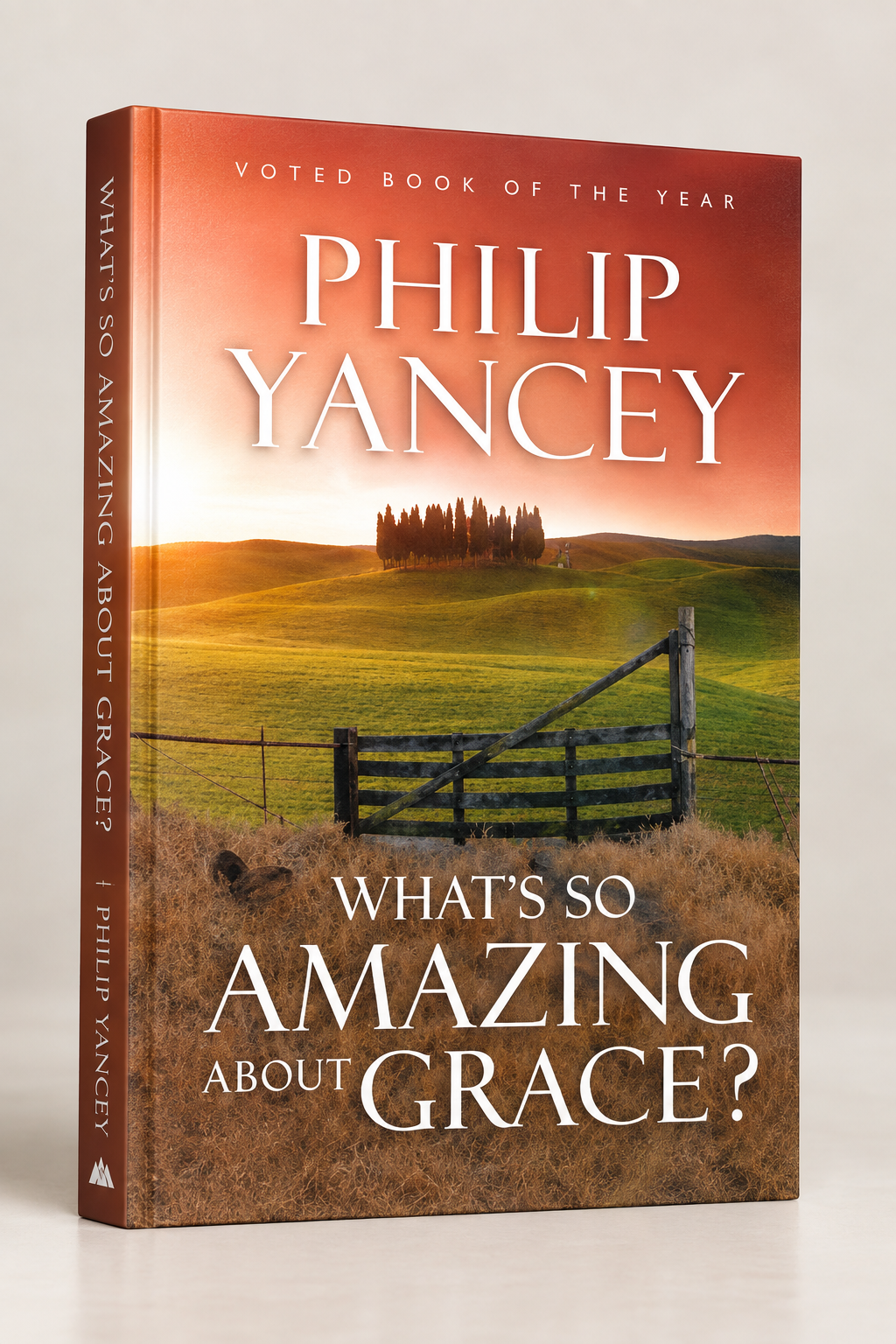
Number 4 on the list: What's So Amazing About Grace? — by Philip Yancey
Philip Yancey's What's So Amazing About Grace? challenged me in a very different way.
It made me think about something Christians speak about constantly: grace. We sing about it. We
preach about it. We quote Ephesians 2:8. We talk about being saved by grace. But do we actually live like people who understand grace? Grace is God's unmerited favour. It is receiving what we could never earn and could never demand as a right. And yet one of the uncomfortable realities this book brought into focus for me was the disconnect that can sometimes exist between the grace Christians proclaim and the grace Christians extend to one another.
It is possible to understand grace doctrinally while struggling to demonstrate it relationally. We can become remarkably good at identifying sin while becoming remarkably poor at extending mercy. That challenged me. Jesus did not merely teach grace as an abstract theological concept. He demonstrated it in the way He interacted with people.
The woman caught in adultery. Zacchaeus. The prodigal son. Peter after his denial. The thief on the cross.
Again and again, we encounter a Saviour who meets broken people with something they did not deserve. His ministry of healing, deliverance, and reconciliation was entirely based on the riches of God’s Grace. That does not mean that grace ignores truth or calls sin righteousness. Rather, grace changes the posture with which we approach people who need redemption which, ultimately, is all of us. This book made me ask myself a difficult question:
If I have received such extraordinary grace from God, how much of that grace is visible in the way I treat other people?
That question alone makes the book worth reading.
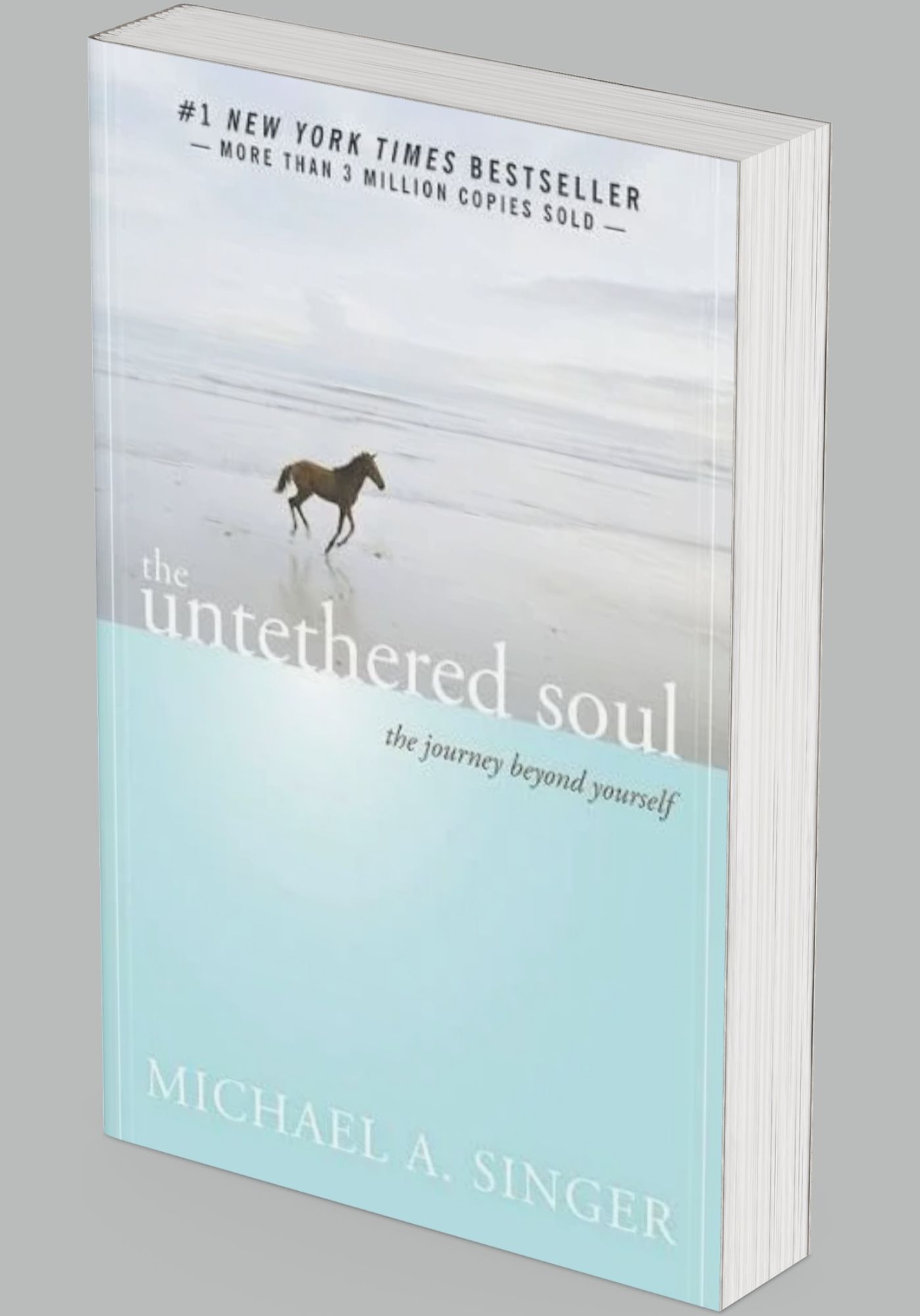
Book 3 on the list: The Untethered Soul — Michael A. Singer
At first glance, The Untethered Soul may seem like an unusual recommendation for a Christian reading list. It isn't a Christian book in the conventional sense, and I certainly wouldn't recommend approaching every spiritual concept in it uncritically.
But this is precisely why I found it valuable. It challenged me to examine and discern the voice inside my own head.
We spend our lives listening to our thoughts, reacting to our emotions, protecting our identities and trying to control circumstances so that we can feel safe. But what happens when we begin to observe those thoughts rather than automatically obey them? The book caused me to think deeply about fear. Fear ultimately leads to some form of bondage or the other. We fear rejection, failure, loss, uncertainty and the opinions of other people. We seek external validation because we want something outside ourselves to tell us that we are enough. But true freedom begins when we no longer allow fear to dictate our identity and our choices.
For me, this is connected with an important spiritual truth: our external circumstances do not have to determine the condition of our inner life.
There is a spiritual dimension to being human that cannot be reduced to our physical circumstances. Jesus repeatedly directed people's attention beyond what was immediately visible. He spoke about the heart. He spoke about the inner person. He spoke about what is happening within us. That is why The Untethered Soul became meaningful to me. It encouraged me to become more conscious of what was happening inside me rather than allowing every thought, emotion or fear to become my master. Freedom does not necessarily mean that fear disappears.
Sometimes freedom means feeling fear maybe even acknowledge it but not giving it deciding powers.
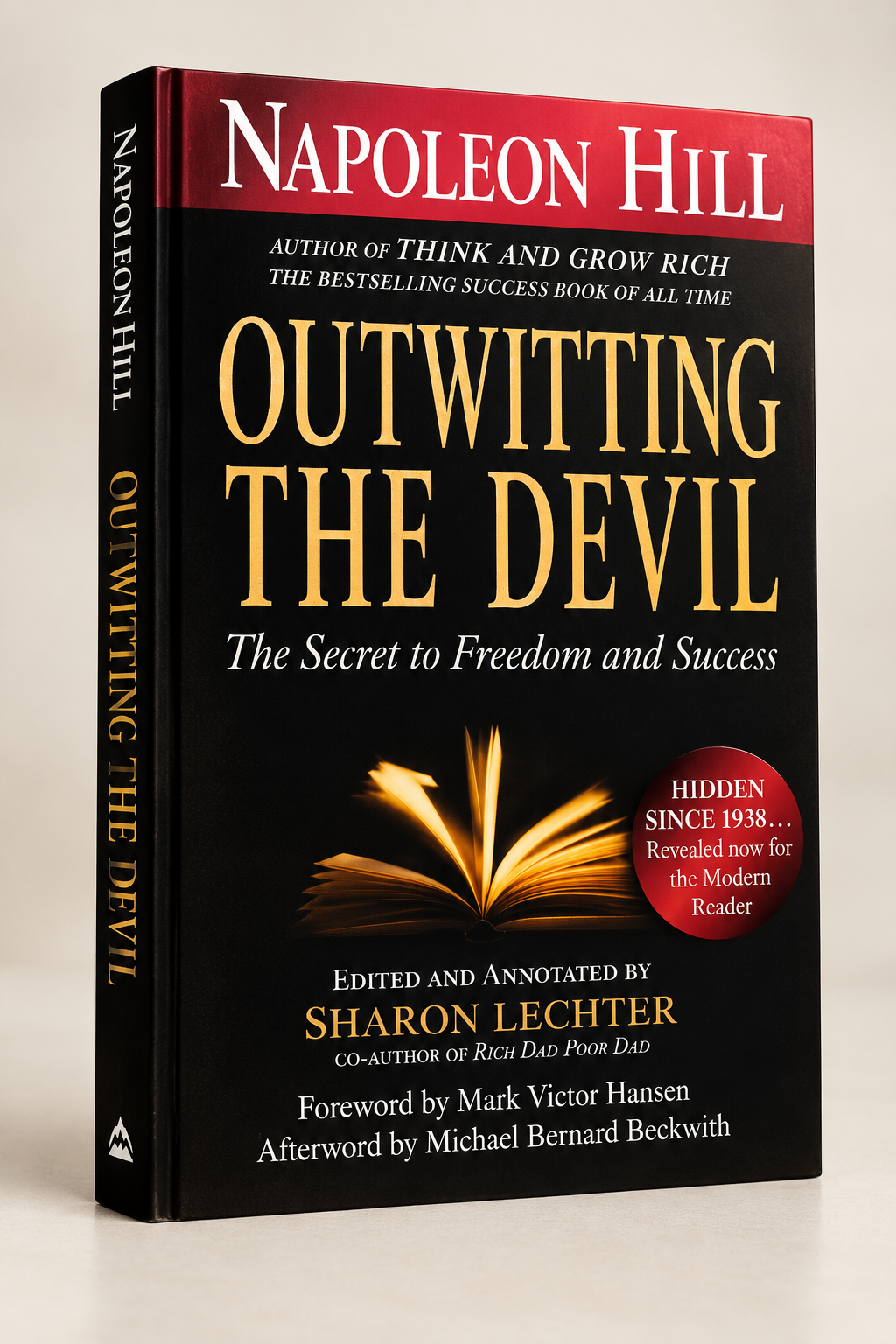
Book 2 on my list. Outwitting the Devil — Napoleon Hill
Napoleon Hill's Outwitting the Devil was perhaps one of the more provocative books on my list. It challenged me to think about how easily human beings can surrender independent thought.
Hill's famous dialogue with the personification of the Devil explores ideas around fear, conformity, drifting and the ways in which people can become controlled by their environment rather than consciously and intentionally determining the direction of their lives. One of the ideas that particularly challenged me was the possibility that institutions we value, invite others to, put our children in and give money to, can also hi-jack our God-given ability to make up our own minds.
Education. Religion. Society. Culture.
These institutions can do enormous good. But they can also become environments in which people simply inherit beliefs, assumptions and behaviours without examining them. That forced me to ask myself:
Do I believe something because I have searched it out for myself—or because someone taught me to believe it?
For a Christian, that is an important question. The Bible does not call us to blind conformity.
Paul writes:
“And be not conformed to this world: but be ye transformed by the renewing of your mind...”
— Romans 12:2, KJV
The Christian life involves the renewing of the mind.
That means we should be willing to examine what we believe, test what we hear with Scriptures, and renew our thought paradigm ie. our mental framework or lens. The Bereans were commended because they did not simply accept Paul's teaching without examination. They searched the Scriptures to see whether what they were being taught was true. That is the kind of intellectual and spiritual independence that I believe Christians need.
Outwitting the Devil encouraged me to become more conscious of the forces that shape my thinking—and to take responsibility for thinking carefully about what I accept as truth.
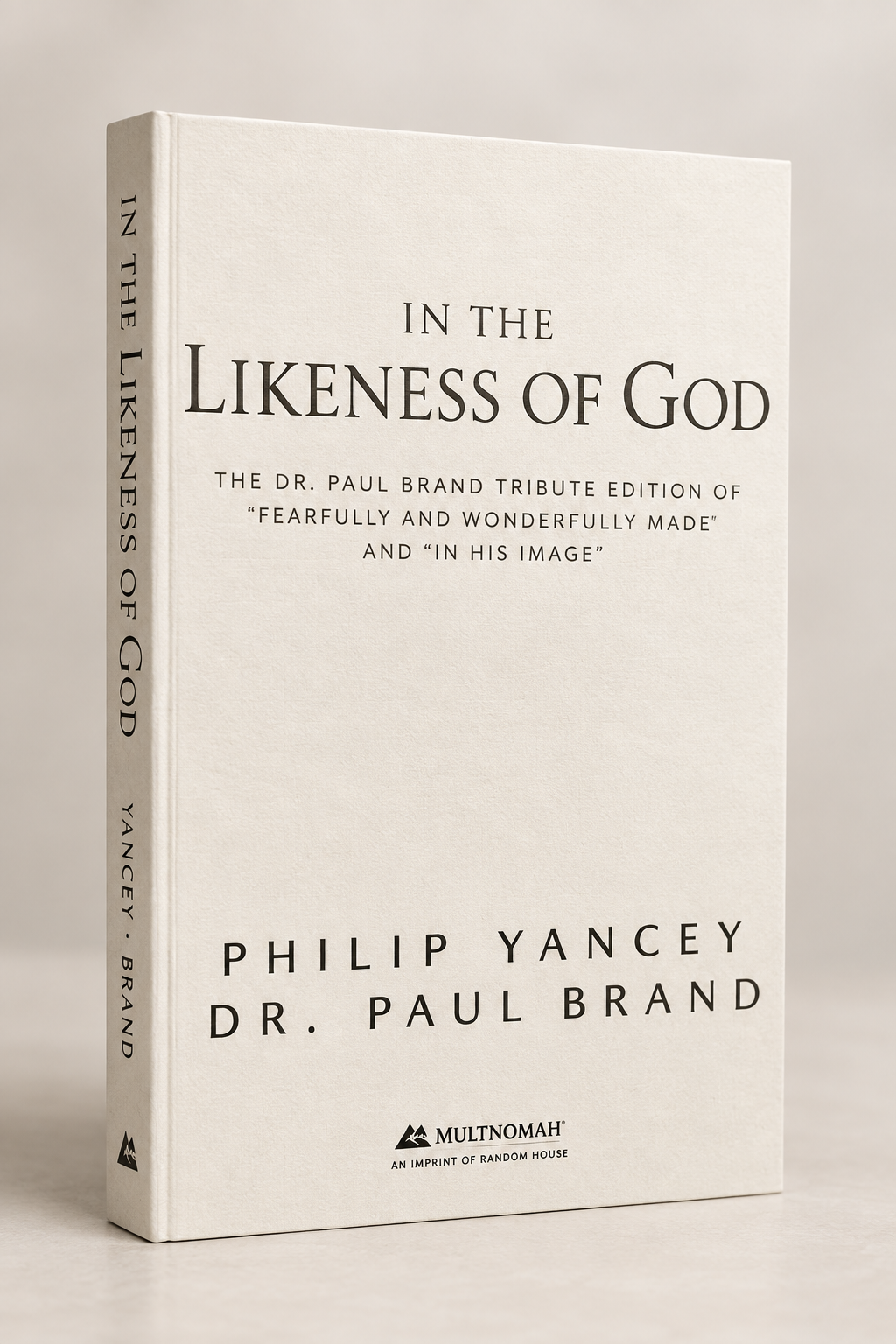
Number 1 on my List. In the Likeness of God — Paul Brand and Philip Yancey
Of all five books, this one probably had the most profound influence on the way I understand the Body of Christ.
In the Likeness of God, by Dr Paul Brand and Philip Yancey, explores the human body and uses it as a window through which to consider spiritual truths about humanity and God. One of the ideas that remained with me is the extraordinary interconnectedness of the human body. Every cell has a function. Every part contributes to the whole. No individual cell exists merely for itself. A cell disconnected from its neighbour and Jesus is called cancer.
And this brought me back to Paul's teaching about the Body of Christ.
The Church is not simply a collection of people who happen to believe the same things. We are described as a body. Paul writes:
“For as the body is one, and hath many members, and all the members of that one body, being many, are one body: so also is Christ.”
— 1 Corinthians 12:12, KJV
This changed the way I think about the individual believer. You matter. I matter. Not because you have a platform. Not because you preach. Not because thousands of people know your name. Not because you occupy a prominent position in a church. You matter because God has designed you to have a function within His Body.
And there is something else that I believe is essential:
The Body must remain connected to its Head. The Head of the Church is not a pastor. It is not a denomination. It is not a theological institution. It is not a celebrity Christian.
The Head is Christ. Paul describes Christ as:
“the head of the body, the church...”
— Colossians 1:18, KJV
That has enormous implications.
Just as the human body cannot function properly when it is disconnected from the signals of its head, the Body of Christ cannot function as God intended when individual believers lose their connection with Christ. Yes. We each have a role. We each have a function. We each have something to contribute. And yet none of us is the Head.
Jesus is.
That realisation has profoundly influenced how I understand my own place within Christianity. As well as everyone else's, there is nothing more liberating than seeing people through the lens of their role in your life and the body. I don't need to be someone else. I don't need to perform someone else's calling. I don't need to compete with another member of the Body. I need to remain connected to the Head and faithfully fulfil the function God has given me.
That is freedom.
Five Books, Five Lessons
Looking back at these five books, I realise that each one opened a different door for me.
This Present Darkness, opened my eyes to the unseen spiritual battle and the importance of prayer.
What's So Amazing About Grace?, taught me to think more deeply about the grace I have received—and whether I extend that same grace to others.
The Untethered Soul, challenged me to examine my inner life, particularly the relationship between fear, attachment and freedom.
Outwitting the Devil, challenged me to examine the forces that shape my thinking and to value independent thought.
And In the Likeness of God, gave me a deeper appreciation for the Body of Christ and the unique function of every believer who remains connected to Christ, the Head.
None of these books replaced Scripture for me. That distinction is vital.
The Bible remains my foundation.
But God can use many things—including books written by imperfect human beings—to provoke us to think, to ask better questions, to examine ourselves and ultimately to return to His Word with greater understanding. For me, that is what these books did. They didn't simply give me answers. They gave me questions worth asking.
And sometimes a good question, sincerely taken before God and His Word, can become the beginning of profound spiritual growth.
So, would I recommend these five books? Yes.
But I would recommend them with an invitation:
Read critically. Read prayerfully. Search the Scriptures.
Don't read a book simply because someone tells you it is Christian. Don't reject an idea simply because it challenges you. And don't accept an idea simply because it sounds spiritual.
Think. Question. Test. Search. Pray.
And above all, remain connected to the Head.
Jesus Christ, the Son of God.
The Stories Behind the Five Books
One of the things I love about books is that there is often another story behind the story.
Sometimes the author's life explains why a particular book exists. Sometimes the circumstances surrounding its publication are almost as fascinating as the book itself. And occasionally, the history of a book gives you an entirely different appreciation for what you are holding in your hands.
These five books have particularly interesting stories.
5. This Present Darkness — Frank E. Peretti
The author behind the book
Frank E. Peretti was born in Lethbridge, Alberta, Canada, in 1951 and grew up in the Seattle area. Before becoming a bestselling novelist, he worked in ministry and also had a background in music and storytelling.
Peretti became one of the most influential writers in the development of modern Christian fiction. His novels are particularly known for bringing supernatural themes, spiritual warfare and questions of good and evil into contemporary settings.
His writing was unusual for Christian publishing at the time because he wrote essentially as a thriller writer—but with an explicitly Christian worldview.
The story behind This Present Darkness
Published in 1986, This Present Darkness was Peretti's first adult novel. It centres on the fictional town of Ashton, where events taking place in the physical world are connected to an unseen battle involving angels and demons.
Interestingly, the book was rejected by fourteen publishers before Crossway eventually published it.
It also wasn't an immediate bestseller.
Its popularity grew through word of mouth, and gospel singer Amy Grant's public promotion of the book helped bring it to a much wider audience. It subsequently remained on the Christian Booksellers Association bestseller list for more than 150 consecutive weeks and has sold more than 2.7 million copies.
The title itself comes from Ephesians 6:12, the passage in which Paul describes the Christian struggle against “the rulers of the darkness of this world” and spiritual forces of evil.
That is significant because Peretti wasn't simply writing a horror story with Christian characters. He was attempting to visualise Paul's teaching about spiritual warfare. For me, that is precisely what made the book so memorable.
It caused me to think about prayer differently and to consider the possibility that what appears to be an ordinary physical circumstance may have a spiritual dimension that we cannot see.
And although it is a work of fiction, the questions it raises about prayer, spiritual warfare and the unseen realm stayed with me long after I finished the book. I began seeing the evidence all around me, like when you shop for a particular car and then suddenly you see it everywhere.
4. What's So Amazing About Grace? — Philip Yancey
The author behind the book
Philip Yancey became one of the most recognisable Christian writers of his generation.
A journalist and writer who spent many years associated with Christianity Today, Yancey became known for approaching difficult Christian questions through journalism, personal stories, historical events and honest reflection. His books have explored subjects including suffering, doubt, grace and the person of Jesus.
What's So Amazing About Grace? became one of his best-known works.
What inspired the book?
The origins of this book are particularly interesting.
Yancey has explained that the idea was partly prompted by a conversation with then-President Bill Clinton.
During an interview, Clinton asked him why Christians seemed to express so much hatred.
That question stayed with Yancey.
He initially conceived a book with the much more provocative working title:
“What's So Amazing About Grace and Why Don't Christians Show More of It?”
The publisher ultimately shortened the title to What's So Amazing About Grace?
The book was published in 1997.
One of its most memorable themes is the contrast between the grace Christians proclaim and the “ungrace” that people sometimes experience from Christians themselves.
Yancey uses stories from history, Scripture and ordinary life to ask what grace actually looks like when it leaves the pages of theology and enters the real world.
One of the stories that profoundly shaped the book concerns Gordon Wilson, whose daughter was killed in the 1987 Enniskillen bombing in Northern Ireland. Wilson survived the bombing and publicly expressed forgiveness toward those responsible. His response became one of Yancey's powerful illustrations of grace in action.
The book went on to win the Christian Book of the Year Award, the Gold Medallion Award and the Retailers Choice Award.
There is another interesting detail: the book has never really stopped evolving. A revised and updated edition was published in 2023, with new material, a new preface and a reflection guide.
3. The Untethered Soul — Michael A. Singer
The author behind the book
Michael A. Singer is a very different kind of author from the others on this list.
He studied economics at the University of Florida, receiving his master's degree in 1971. During his doctoral studies, he experienced what he describes as a profound inner awakening and subsequently withdrew from conventional academic life for a period of spiritual exploration, including yoga and meditation.
In 1975, he founded the Temple of the Universe, a meditation and spiritual centre open to people of different religious backgrounds.
This background is important because The Untethered Soul is not a Christian book.
Singer draws on meditation, mindfulness and spiritual traditions outside Christianity as he explores consciousness, thought, emotion and the nature of the self.
That makes this an unusual book to find on my list of books that shaped me as a Christian.
And that is precisely why I included it.
The book itself
The Untethered Soul: The Journey Beyond Yourself was published in 2007.
Its central question is deceptively simple:
Who are you?
Singer asks the reader to distinguish between the person who experiences thoughts and emotions and the thoughts and emotions themselves.
The book explores the “voice inside your head,” emotional reactions, fear, attachment, inner energy and the possibility of becoming an observer of one's own mental activity.
It eventually became a New York Times bestseller.
Why a Christian would read it
I would not recommend reading The Untethered Soul as though it were a Christian theological text.
It isn't.
But I found something valuable in allowing it to challenge the way I thought about my inner life. It made me more conscious of the difference between what I think and who I am. It made me examine fear. It made me question how much of my behaviour is driven by the need for approval, security and external validation.
And it made me think about the extraordinary biblical emphasis on the transformation of the mind, the heart and the inner person.
Sometimes a book doesn't have to give you the answer to be valuable.
Sometimes it gives you a question that sends you back to Scripture with new eyes.
2. Outwitting the Devil — Napoleon Hill
The author behind the book
Napoleon Hill was born in 1883 in a one-room cabin in Wise County, Virginia.
He began his writing career remarkably young, at thirteen, he was already writing for small-town newspapers.
He eventually became one of America's most famous motivational writers, best known for Think and Grow Rich, published in 1937. The Napoleon Hill Foundation describes that book as his most famous work and one of the landmark works in the philosophy of personal achievement.
Hill died in 1970.
But one of his most controversial books had already been sitting unpublished for decades.
The extraordinary story of Outwitting the Devil
Hill wrote Outwitting the Devil in 1938, shortly after the phenomenal success of Think and Grow Rich.
And the premise is extraordinary.
Hill conducts a fictional interview with the Devil.
But this isn't the traditional theological image of Satan with horns and a pitchfork.
Hill uses the Devil as a personification of the forces that prevent human beings from exercising their potential—particularly fear, procrastination, anger, jealousy, ignorance and what he calls “drifting.”
The Devil essentially becomes a literary device through which Hill examines how human beings surrender control of their minds.
And that is where the book becomes particularly provocative.
Hill attacks what he sees as systems that encourage people to stop thinking independently. His discussion includes religion, education and social institutions.
The manuscript was considered too controversial to publish and remained unpublished for more than seventy years. The Napoleon Hill Foundation states that it was ultimately released decades later, with the 2011 edition edited and annotated by Sharon Lechter.
The idea that challenged me most
One of Hill's most interesting concepts is the idea of the “drifter.”
The drifter is someone who moves through life without consciously determining the direction of his or her own mind and life.
Hill connects drifting with fear, social conditioning and the tendency to accept ideas simply because they are presented to us by authority. That idea made me ask a deeply important question as a Christian:
Do I believe something because I have searched the Scriptures and become convinced of its truth—or because someone I trust told me to believe it?
That is a question every believer should be willing to ask.
For me, Outwitting the Devil became less about Napoleon Hill's philosophy and more about the importance of thinking deliberately.
It reminded me that faith does not justify intellectual laziness.
1. In the Likeness of God — Paul Brand & Philip Yancey
The two men behind the book
This book has perhaps the most extraordinary author partnership of the five.
Philip Yancey was a journalist and Christian writer.
Paul Brand was a pioneering surgeon.
But Paul Brand was not simply any surgeon.
Born in India in 1914 to missionary parents, Brand grew up in the mountains of Tamil Nadu. He eventually travelled to Britain for his education and studied medicine at University College Hospital in London.
During the Second World War, he worked as a casualty surgeon during the London Blitz.
In 1946, he returned to India with his wife, Margaret, also a doctor, to work at the Christian Medical College in Vellore. There he encountered people suffering from the devastating effects of leprosy, now generally referred to as Hansen's disease.
What he discovered changed medical understanding of the disease.
People with leprosy were suffering devastating injuries largely because the disease damaged their nerves and removed their ability to feel pain.
Brand realised that pain, which we naturally regard as an enemy, is actually one of the body's great protective gifts.
He pioneered reconstructive techniques, including tendon transfers, that helped restore function to people whose hands had been severely affected. He also became a major figure in the development of hand surgery and rehabilitation.
How does a surgeon end up writing theology?
This is what makes In the Likeness of God so fascinating.
Paul Brand understood the human body extraordinarily well.
And he saw something in the body that pointed beyond anatomy.
Together with Philip Yancey, he explored the idea that the physical body can illuminate spiritual truths.
The original books were:
Fearfully and Wonderfully Made published 1980
And
In His Image published 1984.
After Brand's death in 2003, the two works were brought together in the 2004 Dr. Paul Brand Tribute Edition, In the Likeness of God. The volume contains the complete texts of both books and additional material, including eight litanies of praise concerning the human body.
The resulting book is more than 550 pages long.
And its central idea is remarkable:
The human body itself can teach us something about God’s plan for humanity today.
The authors examine things such as cells, blood, the head, the spirit and pain, using the physical structure and function of the human body as a way of exploring spiritual realities.
Five Authors. Five Very Different Journeys.
When I look at these five books together, I am struck by how different the authors are.
A Christian novelist who imagined spiritual warfare.
A journalist who wrestled with the Church's understanding of grace.
A spiritual teacher who explored consciousness and the inner life.
A motivational philosopher who personified the Devil and challenged conformity.
And a Christian surgeon who looked at the human body and saw something of the Creator reflected in its design.
Their backgrounds could hardly be more different. And yet each book gave me something worth carrying forward. That is why I don't believe Christians should be afraid of reading widely. We don't need to agree with every author we read. We don't need to adopt every philosophy we encounter. And we certainly shouldn't allow a book to replace Scripture.
But we can read, examine, question, test and learn.
The Bereans were commended because they searched the Scriptures to determine whether what they were being taught was true.
That is a beautiful model for Christian reading.
Continue the Journey
If these books have inspired you to look deeper, question familiar ideas, and explore your faith with fresh eyes, you may enjoy continuing the journey through my own devotional series, Twelve Divine Treasures for the Narrow Road.
Created for readers who desire to grow in their understanding of God and His Word, each book explores a different divine treasure and invites you to reflect more deeply on the narrow road of faith.
Discover the series and explore my books here:
Olivia Grace Pitt – Books
Keep reading. Keep seeking. Keep growing.